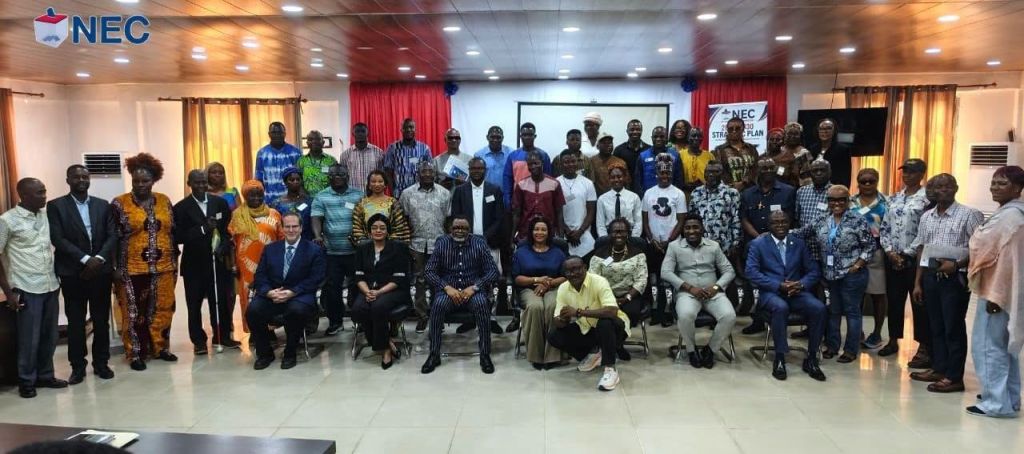
NEC Headquarters, Monrovia, Liberia | Thursday, 19 November 2026 – The National Elections Commission of Liberia (NEC) has called on electoral stakeholders, civil society organizations, government institutions, development partners, and the media to collectively strengthen Liberia’s Civic and Voter Education (CVE) framework, describing it as more than a policy document but a national commitment to informed citizenship and democratic participation.
Delivering the opening statement on behalf of the NEC Board of Commissioners (BoC) at the ongoing validation workshop on Thursday, 19 November 2026, Commissioner Cllr. Ernestine Morgan Awar emphasized that the strategy represents a promise to strengthen civic awareness, promote inclusive participation, and advance democratic governance in Liberia.
“Today, as we proceed in validating, let us be reminded that this is not just a document, but a promise,” Commissioner Awar declared.
She stressed that civic and voter education must go beyond election periods, describing it as a continuous process that empowers citizens to understand their rights, responsibilities, and roles in democratic governance.
This continuous approach, she noted, is essential for building a culture of active citizenship rather than confining civic engagement to the brief windows of electoral cycles.
According to Commissioner Awar, the proposed five-year strategy (2026–2030) seeks to establish a coordinated framework for promoting informed citizenship, inclusive participation, understanding of electoral processes, peaceful political engagement, and public confidence in democratic institutions.
The strategy is designed to address existing gaps in civic knowledge, counter misinformation and disinformation, and foster a shared sense of national ownership over electoral processes.
She further highlighted the importance of collaboration among electoral stakeholders, government institutions, civil society organizations, the media, development partners, and community-based structures in ensuring sustainable civic and voter education interventions.
Each of these actors, she explained, brings distinct strengths and reach, from the grassroots networks of community-based organizations to the mass communication capacity of the media and the technical and financial resources of development partners, making a coordinated, multi-stakeholder approach indispensable.
Commissioner Awar explained that the validation exercise provides an important opportunity to assess the strategy’s relevance to the country’s current civic and electoral environment, examine the practicality of its proposed objectives, and incorporate lessons learned from previous electoral processes, particularly the 2023 General Elections.
Those lessons, she indicated, include the need for earlier and more sustained civic education, clearer communication about electoral procedures, and stronger outreach to communities that have historically been underrepresented in civic dialogue.
She also underscored the need to ensure that the strategy responds to the civic and voter education needs of all segments of society, especially women, young people, first-time voters, persons with disabilities, and other underserved and vulnerable groups.
Tailored outreach, accessible formats, and inclusive messaging, she noted, are critical to ensuring that no citizen is left behind in the democratic process.
Beyond reviewing the document, the Commissioner urged stakeholders to critically examine its implementation arrangements, coordination mechanisms, resource requirements, monitoring and evaluation framework, and sustainability measures to ensure that the final strategy translates into practical and measurable interventions.
She emphasized that a strategy is only as strong as its implementation plan, and called for realistic costing, clear lines of accountability, and a robust monitoring system capable of tracking progress and adapting to emerging challenges.
She concluded with a call for unity and sustained commitment to democratic participation, urging stakeholders to ensure that the country’s electoral journey produces meaningful outcomes for every citizen.
The NEC expects the validation process to culminate in a national CVE Strategy that is relevant, inclusive, evidence-informed, implementable, and collectively owned by the institutions and stakeholders responsible for its execution throughout the 2026–2030 period.
The Commission envisions the strategy as a living framework, one that will be periodically reviewed and refined in response to lessons learned and changing circumstances.
The validation exercise forms part of the Commission’s broader efforts to strengthen civic awareness, deepen democratic participation, and build a more informed electorate ahead of future electoral processes.
It reflects the NEC’s recognition that credible elections depend not only on well-administered polling day operations but also on an informed, engaged, and empowered citizenry.
##
Related Articles

Dialogue on Constituency Boundary Delimitation Intensifies Among Electoral Stakeholders
Nov 25, 2026
NEC BEGINS REVIEW OF VAWE PROTOCOLS AHEAD OF 2029 GENERAL ELECTIONS
Nov 9, 2026
Stronger Media-Security Cooperation Needed to Safeguard Liberia’s Electoral Process
Nov 6, 2026
Comments 0