ULL PRESS STATEMENT BY THE BOARD OF COMMISSIONERS (BOC) RELATING TO THE BUDGET FOR THE CONDUCT OF THE 2029 GENERAL ELECTIONS, AND THE COMPLIANCE STATUS OF POLITICAL PARTIES OPERATING IN LIBERIA
Delivered by: Hon. Jonathan K. Weedor, Chairman, National Elections Commission (NEC)
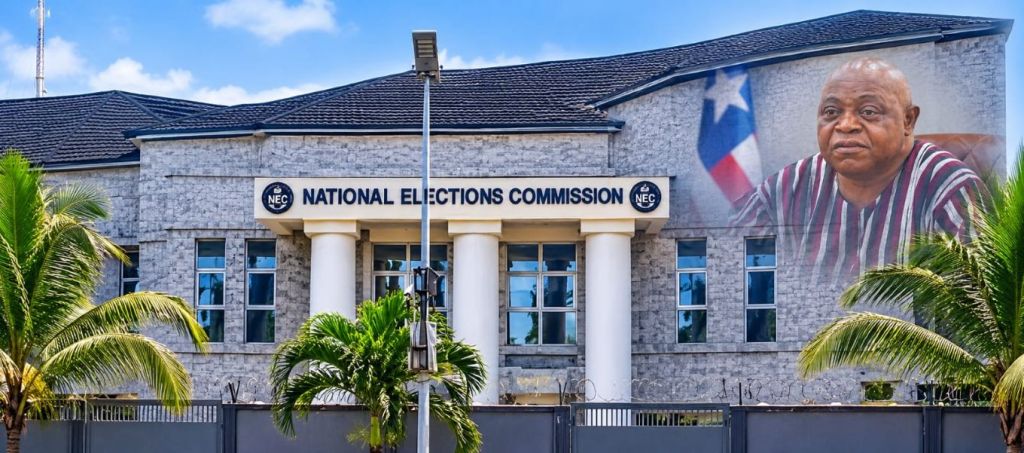
James M. Fromayan Hall, NEC Headquarters, Monrovia, Liberia
Monday, 23 November 2026,
2:00 P.M.
Fellow Commissioners, the Executive Director, Deputy Executive Directors, Staff of the National Elections Commission of Liberia;
Representatives of Political Parties;
Civil Society Organizations;
Development Partners;
Members of the Press;
Fellow Liberians:
On behalf of the Board of Commissioners (BoC) of the National Elections Commission of Liberia (NEC-Liberia), I welcome you to this important press conference convened to provide the Liberian people with a comprehensive update on two critical matters concerning the work and future of the Commission. At this time, we deem it necessary to inform the Liberian people relating to the cost for the conduct of the 2029 Presidential and Legislative Elections, and the compliance status of political parties operating in Liberia.
In this regard, we wish to inform the Liberian people that the NEC has submitted to the National Legislature and the Ministry of Finance and Development Planning (MFDP), a proposed budget of US$89,545,353.92 (Eighty-Nine Million, Five Hundred and Forty-Five Thousand, Three Hundred and Fifty-Three United States Dollars and Ninety-Two Cents) to support the Commission’s electoral operations over three years, 2027–2029.
The budget represents an increment of 40 percent from the cost of the 2023 General Elections. The increment is based on three cardinal factors:
- Increase in the number of voting precincts across the country from 2,080 to 2,500. For the 2029 electoral cycle, the Commission’s operational projections provide for an additional 420 precincts, bringing the projected total to 2,500 voting precincts. According to the UN global population census, the Commission’s current operational worksheet uses an estimated national population of 5,885,979. It further provides for approximately 10,000 polling places, based on an average of 4 centers per precinct. Accordingly, the Commission will target approximately 2.7 million eligible voters during the voter registration exercise for the 2029 General Elections. The voter registration exercise will be conducted during the first quarter of 2028.
- The provision of Starlink Internet Services to strengthen internet connectivity across the NEC operational areas throughout the country, and between and amongst field offices, and coordination between Headquarters and field offices.
- Verifiers – Information and Communication Technology and Biometric Voter Registration
More than 10,000 verifiers will be procured to ensure the verification of voters prior to the casting of ballots. This will prevent any voter from voting more than once, thus protecting the principle of ‘one man, one vote’.
The budget is structured around three implementation phases:
Phase I – 2027: US$32,500,581.58 – To ensure timely procurement of biometric equipment that are indispensable to the voter registration process. This amount should be provided at the end of March 2027.
Phase II – 2028: US$12,903,002.11 – This amount will ensure the execution of the voter registration exercise. A large portion of this amount will cover personnel costs, logistics for deployment and retrieval of personnel and materials.
Phase III – 2029: US$44,141,770.23 – This component will cover the cost of balloting and associated personnel and other costs.
The Commission emphasizes that credible elections are not organized overnight. They require extensive planning, technical preparation, institutional investment, adequate resources, and sustained coordination among electoral stakeholders. Our responsibility as Electoral Management Body (EMB) is therefore to prepare sufficiently ahead of time to avoid unnecessary delays, operational weaknesses, and last-minute financial pressures that could affect the conduct of credible elections. The proposed budget is intended to provide the financial support necessary for the Commission to discharge its constitutional and statutory responsibilities.
Members of the press: the proposed three-year budget covers several critical areas of institutional and electoral investment, including the following:
- Communications and Public Information
The Commission recognizes that effective electoral administration requires more than technical and logistical preparations. It also requires sustained public engagement and timely dissemination of accurate information.
- Geo-Information Services
Support for GIS is an important investment for geographical mapping, electoral boundary-related information, spatial data management, and other location-based requirements that support effective electoral planning and administration.
- Civic and Voter Education
The Commission is committed to ensuring that citizens are adequately informed about their rights, responsibilities, and participation in the democratic process. The Commission intends to strengthen civic and voter education, promote inclusive electoral participation, and ensure that women and other traditionally underrepresented groups are adequately informed to enable them to participate in the electoral process. Adequate voter education will erase or minimize invalid votes.
- Political Affairs and Stakeholder Engagement
This provision recognizes the importance of sustained engagement with registered political parties, independent candidates, and other relevant electoral stakeholders. This effort is essential to ensure the building of trust among political actors, giving rise to a peaceful electoral process.
- Institutional Operations and Personnel
The proposed budget also provides for the Commission’s operational requirements at headquarters and across its 19 magisterial offices in the 15 counties. Such provisions are necessary to support the Commission’s administrative responsibilities, field operations, personnel requirements, legal processes, institutional oversight, and performance monitoring.
ELECTIONS 2029 AND RUN-OFF ELECTION PREPAREDNESS
The budget makes specific provisions for the conduct of the 2029 General Elections and a possible run-off election. The inclusion of a run-off election reflects the need for comprehensive contingency planning within the electoral budget. The Commission has a responsibility to prepare for constitutionally anticipated electoral scenarios and ensure that the necessary resources are available should a run-off become necessary.
MODERNIZING NEC OPERATIONS AND INFRASTRUCTURE
Distinguished members of the press: Apart from the 2029 elections budget, the Commission also submitted to the National Legislature and the Ministry of Finance and Development Plaining (MFDP), a proposed recurrent budget for 2027 that reflects a commitment to institutional modernization and improved service delivery. The proposed recurrent budget of US$14,374,284.92 will address several important institutional investments, including the construction of a modern NEC Data Center. This will strengthen the NEC’s technological infrastructure, data management, storage, processing, and information security capabilities.
Also, the construction of 17 NEC guesthouses in 14 of Liberia’s 15 counties, excluding Montserrado County. This initiative is intended to address accommodation challenges associated with NEC personnel, particularly during major electoral operations, field assignments, training exercises, and other official activities. The initial four guesthouses are planned for Nimba, Bong, and Grand Bassa Counties.
Additionally, the relocation of elections magisterial offices from cities of lower population to those of higher population is also considered in the recurrent budget. This decision is intended to meet operational needs such as reducing distances between areas where voters are concentrated and the deployment and retrieval of personnel and electoral logistics.
THE COMMISSION’S COMMITMENT TO FINANCIAL ACCOUNTABILITY
Ladies and gentlemen: The Commission is fully aware that the proposed US$89.5 million budget is a substantial financial commitment. We equally recognize that public resources must be managed responsibly, transparently, and in accordance with applicable financial and procurement regulations. The presentation of this budget is therefore an opportunity for the Commission to explain the rationale behind its projections and demonstrate the relationship between proposed expenditure and the operational requirements of the 2029 electoral cycle. The Commission remains committed to prudent financial management, accountability, effective procurement processes, and appropriate monitoring of resources allocated to electoral activities.
The Commission will continue to engage relevant institutions and stakeholders as the budgetary process progresses. Our objective is not just to secure funding, but to ensure that the resources provided are translated into effective electoral preparations and improved institutional performance.
POLITICAL PARTIES’ COMPLIANCE STATUS
Distinguished members of the press: The second major issue for today’s engagement with the press is the compliance status of registered political parties operating in Liberia. The National Elections Commission of Liberia, consistent with its regulatory and oversight responsibilities, continues to monitor the activities and compliance of political parties in keeping with applicable electoral laws, regulations, and requirements. Political parties are primary stakeholders in a democratic system. To ensure that they play their rightful roles in our country’s democratic system, the National Elections Commission has undertaken a review of the compliance status of political parties and wishes to inform the public that the outcome places the parties into five categories.
- Political Parties with Headquarters
29 political parties currently have headquarters in Monrovia, consistent with law. We encourage them to maintain their compliance status and continue to conduct their activities in accordance with the laws and regulations governing the operations of political party in Liberia.
- Political Parties without Headquarters
The Commission has further identified 6 political parties for which there are no indications of compliance with the primary legal requirements necessary to maintain their status as registered political parties. This is a matter of serious institutional concern. Consequently, the NEC has decided to grant these parties 60 days, beginning 25 November 2026 to 25 January 2027, to regularize their status. Failure to do so within the period granted will leave the NEC with no alternative but to revoke their certificate of registration in accordance with law.
- Political Parties Currently In Dispute
The Commission has identified 2 political parties currently in dispute. Consistent with its regulatory authority, the Commission will work with these parties to resolve their internal disputes. The Commission is giving these parties between now to the close of January 2027 to resolve their disputes in accordance with applicable legal and regulatory requirements.
- Political Parties Relocating their Headquarters
Furthermore, effective today, 25 November 2026, the Commission is granting 9 political parties that have requested time to relocate their offices a period of 60 days to conclude their relocation activities. Failure to do so will result in penalty action in accordance with the law.
- Political Parties Claiming To Be In Coalition/Alliance
There are 3 political parties claiming to be in a coalition for which they do not have headquarters as required by law. The Commission wishes to emphasize that it recognizes these parties as separate entities. As such, being in a coalition is not justification to operate without an office. Therefore, the 3 political parties have up to 25 January 2027 to regularize their status. Failure to do so, the Commission will revoke their certificate of registration in accordance with law.
PREPARING FOR A CREDIBLE 2029 ELECTORAL PROCESS
Fellow Liberians: The decisions and preparations being undertaken by the National Elections Commission of Liberia are guided by one central objective: ensuring that the country is adequately prepared for the successful conduct of the 2029 General Elections. The proposed three-year budget, institutional infrastructure investments, expansion of voting precincts, genuine biometric voter registration preparations, technological modernization, and political party compliance measures are all interconnected components of this responsibility. The Commission is determined to strengthen its institutional capacity and improve the delivery of electoral services to the Liberian people. Public confidence in elections is built not only on Election Day but through the quality of preparations, transparency of decisions, the inclusiveness of processes, and the Commission’s ability to discharge its responsibilities professionally.
We therefore call on all political parties, civil society organizations, development partners, the media, and citizens to remain engaged with the electoral process. We particularly encourage political parties to maintain compliance with applicable requirements and resolve internal disputes through lawful and appropriate mechanisms. We also encourage the media to continue providing accurate, balanced, and responsible information to the public, especially on issues relating to the electoral process and the Commission’s preparations for 2029. The Commission will continue to provide updates as the implementation of these plans progresses.
CONCLUSION
Distinguished ladies and gentlemen: The National Elections Commission of Liberia remains committed to its constitutional mandate of conducting credible, inclusive, transparent, and peaceful elections in Liberia. The proposed US$89,545,353.92 electoral budget for 2027–2029 represents comprehensive funding required for the Commission’s operations for the next electoral cycle. It is an investment in institutional preparedness, improved electoral administration, technological advancement, and the strengthening of Liberia’s democratic process.
Similarly, our position on political party compliance reflects the Commission’s determination to uphold the laws and standards governing political party registration and operations. We believe that strong electoral institutions require not only adequate resources but also accountability and respect for the rule of law by all electoral stakeholders.
As Chairman of the National Elections Commission of Liberia, I wish to assure the Liberian people that the Board of Commissioners (BoC) remains committed to providing the leadership and oversight necessary to protect the democratic process and consolidate the peace of Liberia.
May God continue to bless the Republic of Liberia.
I thank you!
##