Commission Seeks to Move Civic and Voter Education Beyond Election Periods Ahead of 2029 General Elections
BUCHANAN, GRAND BASSA COUNTY, LIBERIA, October 5, 2026
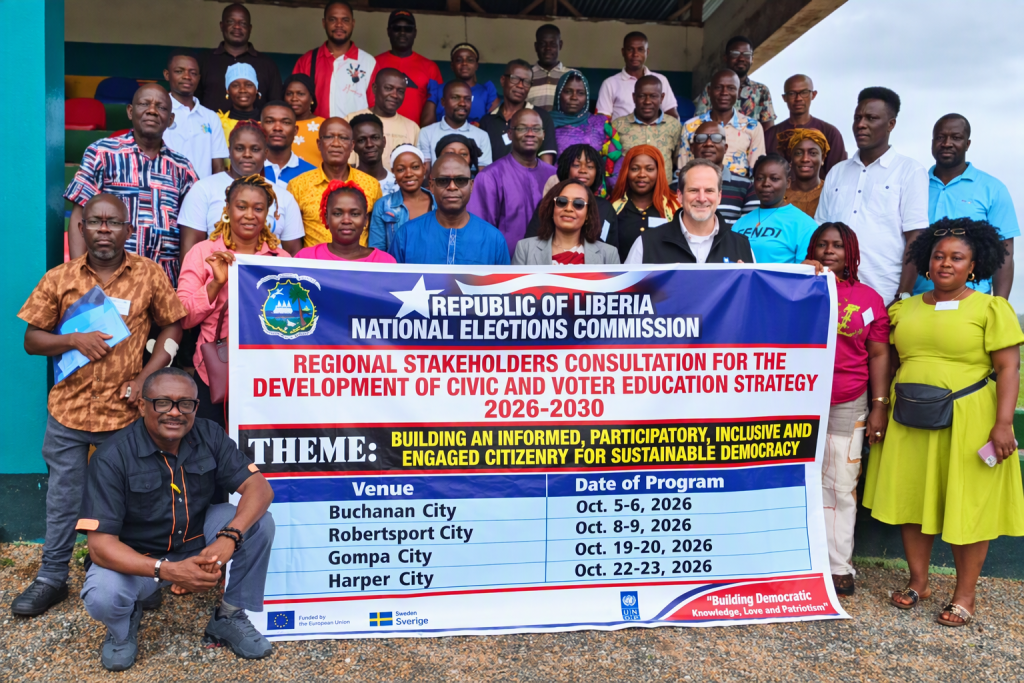
The National Elections Commission of Liberia (NEC) has launched a regional consultation in Buchanan, Grand Bassa County, to gather views from stakeholders on a new Civic and Voter Education (CVE) Strategic Plan for 2026 to 2030, as preparations for the 2029 General Elections gain momentum.
The consultation, held on Monday, October 5, 2026, is part of NEC’s effort to strengthen civic and voter education as a continuous national process that informs citizens, encourages responsible participation, and promotes peaceful engagement beyond election periods.
Speaking at the opening of the consultation, NEC Oversight Commissioner for Civic and Voter Education, Cllr. Ernestine Morgan Awar, stressed that civic and voter education should not be limited to periods immediately preceding elections.
She said sustained public education is essential to helping citizens understand their rights and responsibilities, follow electoral processes, access reliable information, and participate meaningfully in Liberia’s democratic affairs.
Commissioner Awar said the proposed strategy is intended to create a more informed, participatory, inclusive, and engaged citizenry capable of contributing to sustainable democracy.
She explained that continuous engagement with communities would allow citizens to better understand electoral institutions and processes while creating opportunities for concerns and questions to be addressed before they become barriers to participation.
The proposed strategy, titled “Building an Informed, Participatory, Inclusive and Engaged Citizenry for Sustainable Democracy,” is aligned with the United Nations Sustainable Development Agenda, particularly Sustainable Development Goal 4.7.
That global goal promotes education that equips people with knowledge and skills related to sustainable development, human rights, gender equality, peace, global citizenship, and appreciation of cultural diversity.
Under the proposed framework, NEC seeks to ensure that citizens receive accurate and timely information about elections and understand how their participation contributes to democratic governance.
Strategy priorities also include promoting peaceful participation and strengthening public understanding of electoral rights, responsibilities, procedures, and institutions across Liberia.
Commissioner Awar noted that special attention will be given to citizens and communities that often face greater barriers to electoral information and participation.
Women, youth, first time voters, persons with disabilities, and residents of rural communities are among groups expected to receive focused attention under the proposed approach.
A key partner in the consultation process, the United Nations Development Programme Liberia Electoral Support Project (LESP), was represented by Inclusive Electoral Process and Reform Specialist, Mr. Robert Irish.
Mr. Irish described civic and voter education as an important foundation for credible elections and encouraged stakeholders to confront issues that can affect electoral participation and public confidence.
Among concerns highlighted during the engagement were reported incidents of invalid votes, trucking, and questions surrounding the apportionment of seats.
Mr. Irish urged stakeholders to use the consultation process to examine such concerns and contribute practical recommendations that can strengthen future electoral processes.
NEC Deputy Executive Director for External Relations, Mr. Samuel B. Cole, also presented on “Understanding Democracy, Liberia’s Electoral Landscape and CVE Concepts.”
His presentation provided participants with an overview of Liberia’s democratic and electoral environment while examining how effective civic and voter education can help citizens understand and engage with electoral processes.
Proposed activities under the new strategy include the use of multiple communication and community engagement platforms to reach citizens with relevant electoral information.
These platforms include mass media, digital channels, community outreach, educational institutions, town hall meetings, and other community-based approaches designed to reach people where they live, learn, work, and interact.
Participants at the Buchanan consultation include local authorities, civil society organizations, women and youth representatives, community leaders, persons with disabilities, educational and professional institutions, faith-based organizations, development partners, and members of the media.
Their participation is intended to ensure that voices from different sectors and communities are reflected in the development of a strategy that can respond to Liberia’s diverse social and electoral realities.
NEC says experiences, concerns, recommendations, and perspectives gathered during regional consultations will contribute to strengthening the draft CVE Strategic Plan before its finalization.
By broadening consultation beyond election periods, NEC aims to establish a more sustained relationship with citizens and communities, helping ensure that electoral information remains accessible, understandable, and relevant throughout the democratic cycle.
The consultation forms part of NEC’s broader preparations for the 2029 General Elections and reflects its commitment to strengthening public understanding of democratic participation well before Election Day.
A stronger and continuous CVE program is expected to help citizens make informed choices, participate peacefully, and better understand their role in safeguarding Liberia’s democratic gains.
Implementation of the consultation is supported by the UNDP Liberia Electoral Support Project through funding provided by the European Union in Liberia, the Embassy of Sweden in Monrovia, and Ireland.
NEC and its partners say continued collaboration with national and community stakeholders will be important to transforming recommendations from the consultations into practical actions that can strengthen civic participation and inclusive electoral processes across Liberia.
#
Related Articles
COMMISSIONERS JOIN GLOBAL ELECTION LEADERS AT A-WEB CONFERENCE IN THE PHILIPPINES
Oct 15, 2026
NEC Liberia, UN Women Advance Gender and Disability Inclusion Through Staff Training
Oct 14, 2026
BEYOND THE BALLOT: NEC LIBERIA EXPLORES AI-DRIVEN SOLUTIONS TO ELECTORAL CHALLENGES
Oct 14, 2026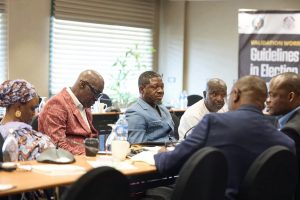
Comments 0